


Europcar
Improving the digital rental journey
My Role and Team
Senior Product Designer
-------------------------
1 PO
1 Proxy PO
2 CRO's
4 Developers
Scope & Impact
Website & App
Booking & Postbooking journey
Goal: Improve CVR of the booking funnel.
Outcome: Aprox +4% CVR through bundles and payment design improvements.
Methodologies
Opportunity Trees
Journey Mapping
Priority Matrix / RICE
A/B Testing
Information Architecture
User Research
Usability Testing & Guerrilla
Design Systems
Workshop Facilitation
Tools
Figma
Maze
Contentsquare
AB Tasty
Dovetail
Typeform
Gemini
Confluence
Role & challenges
Over the last 5 years at Europcar, I worked across the booking funnel, payment experience, post-booking journey and commercial products, using data, experimentation and user feedback to improve conversion and reduce friction.
This work evolved from taking ownership of the entirety of the new post-booking experience to optimizing existing journeys through experimentation, defining design KPIs and aligning them with business OKRs.
Working within a multi-brand organization also meant navigating shared product constraints, limited access to users, and complex stakeholder alignment. The challenges below shaped how I approached the work and the decisions I made.

Access to users
In contrast with laws in Peru, Europs GDPR prevented direct contact with users, requiring alternative recruitment and testing approaches.
Cross-brand impact
A provider change required us to redesign the payment experience, while addressing the needs of multiple brands. I led cross-brand workshops to align on a shared direction, ensuring consistency across the group.
Stakeholder alignment
Different teams had their own priorities and objectives, making it challenging to align everyone around a single direction. With data, experimentation and product knowledge I build consensus and created confidence.
Selected Projects
Across these five years, I worked on projects ranging from new product experiences to conversion optimization and experimentation. The three projects below highlight different ways I approached product design, from owning a journey end to end to improving established experiences through data and testing.
1. Payment Experimentation
From optimization to experimentation: Payment was one of the most critical parts of the booking funnel, becoming the major focus over roughly two years. I worked across payment methods, coupon codes, and loyalty integration to delivery options, Vericheck, price breakdowns, and the payment card interface.
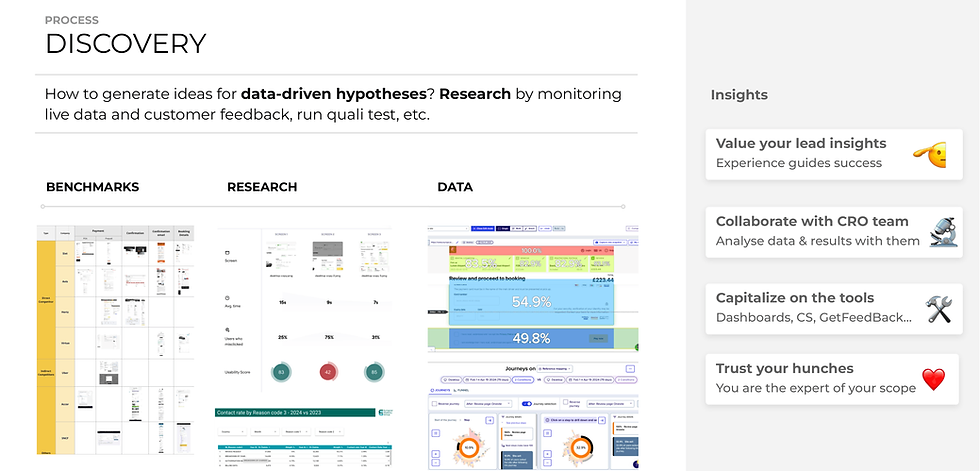
As the experience evolved through multiple iterations, I began working directly with the CRO team when AB Tasty was introduced. With access to this new tool and Contentsquare, I got a new way of understanding the experience through quantitative behavioral data.
From observations to hypotheses: Contentsquare allowed me to move beyond qualitative feedback and identify where users were struggling or behaving unexpectedly. I used these insights, combined with existing user feedback and product knowledge, to formulate 13 experimentation hypotheses with my team across the payment experience.
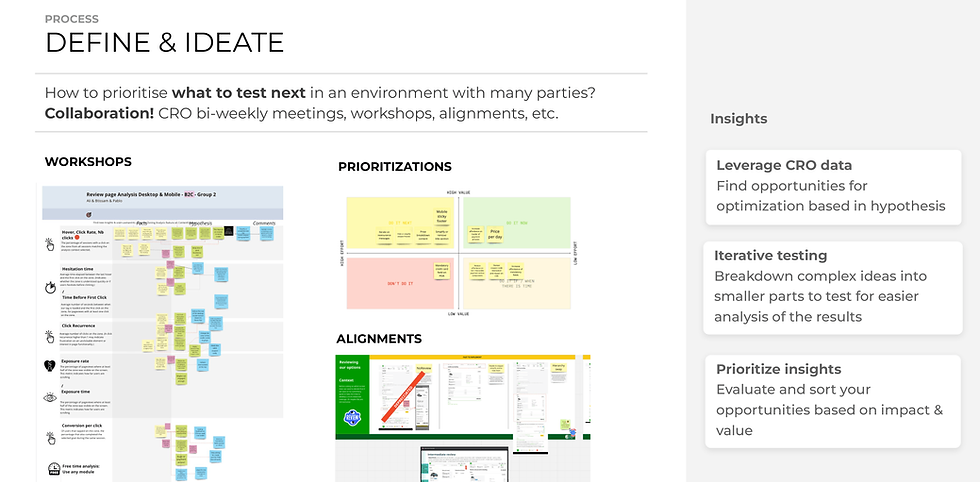
Because testing capacity was limited, the team prioritized which ideas could be taken into experimentation. 6 of my designs were A/B tested during my time on the project. Not every test improved conversion, and that was equally valuable. Negative results helped us avoid investing development effort in changes that did not create measurable value.

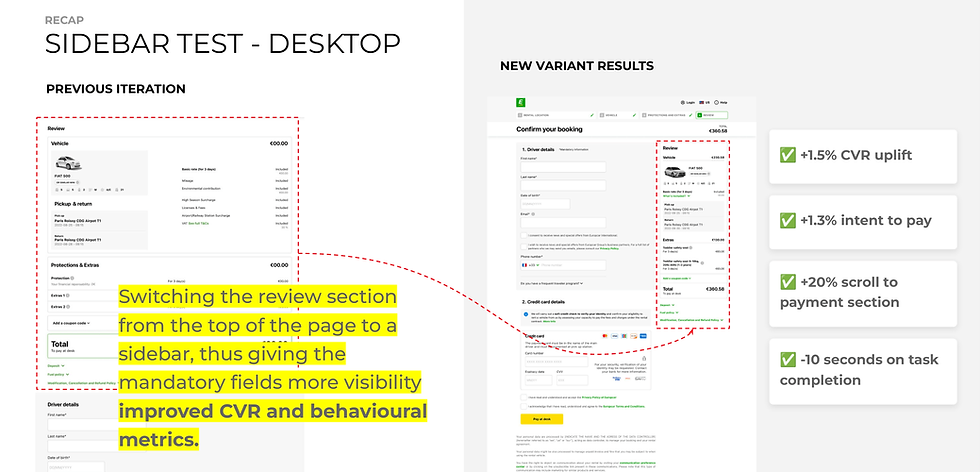
Positive Results: Changing a single primary CTA to active by default improved CVR by 1%. A more complex problem solved was the price breakdown. Through user research and quantitative user behaviour, we observed that the exit rate was higher for users who hovered longer over the price breakdown; the discoverability of the first task to accomplish on this page was also low. Thus, we simplified this section, while allowing the fields to have higher hierarchy. This increased our CVR by 1.5%.
The process: Across the payment experience, experimentation changed how I approached design. Instead of treating the redesign as a single delivery, I could continuously identify friction, formulate hypotheses, and validate them against real user behavior. But arriving at these conclusions involves a process in which the users are the central piece to discover and define.
2. Bundles Optimization
Improving bundle selection and transition to payment: I took ownership of the bundles experience while the designer leading the project went on maternity leave. The goal was to improve the transition from bundle selection to payment while exploring opportunities to increase average order value.
The experience had been performing inconsistently across markets, with mobile showing the biggest decline. I combined Contentsquare behavioral analysis, a Kantar study, competitive benchmarking and usability testing to identify where users were struggling and where the experience could be simplified.

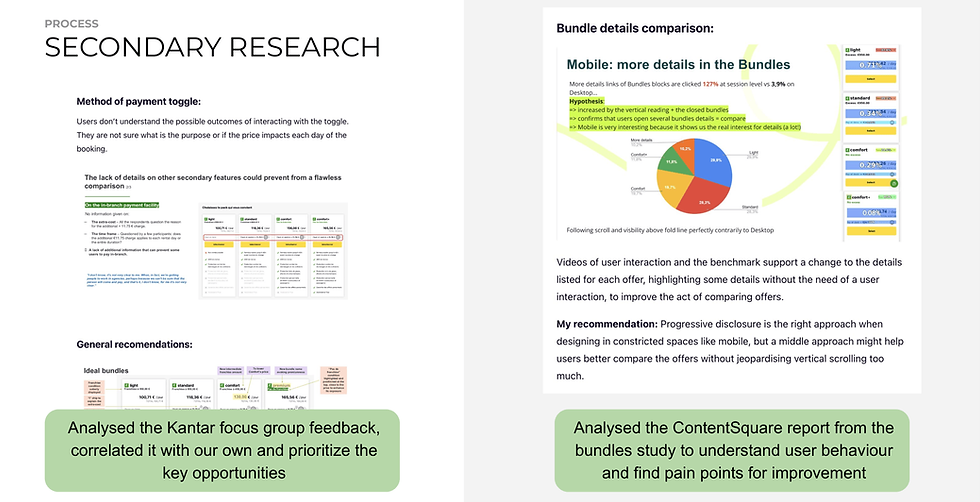
The research revealed three main issues:
High cognitive load
In contrast with laws in Peru, Europs GDPR prevented direct contact with users, requiring alternative recruitment and testing approaches.
Difficult comparison
A provider change required us to redesign the payment experience, while addressing the needs of multiple brands. I led cross-brand workshops to align on a shared direction, ensuring consistency across the group.
Complex payment selection
Different teams had their own priorities and objectives, making it challenging to align everyone around a single direction. With data, experimentation and product knowledge I build consensus and created confidence.
Turning insights into a new direction: I translated these findings into a set of design changes focused on improving these issues.

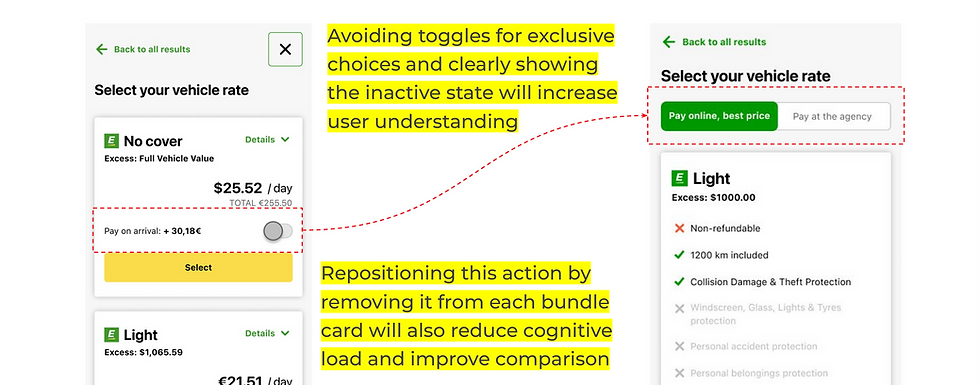
From recommendations to experimentation:
The proposed changes were approved and prepared for A/B testing. I defined the key measures for success around the bundle journey, including:
-
Transition to payment
-
Return to results
-
Interaction with non-interactive elements
-
Task completion time
Results: The subsequent iteration of the experience was associated with a +12% uplift in transition to the payment page, alongside an increase in AOV.

3. Post-Booking Journey
Building a new post-booking journey from scratch: When I joined Europcar, the existing post-booking experience was no longer supported by the underlying web and backend architecture. I was allowed to rethink the journey from the ground up and worked on it over roughly two years, from the initial structure through to implementation, which let us migrate from the legacy experience.
The challenge was to create a coherent experience for both guest and account users, through an online or at agency payment, while supporting a growing set of post-booking actions to provide users with control of their bookings and create opportunities for commercial upsell while doing so. The new experience introduced two entry points depending on the user's context:
Guest users: Booking search → Booking details → Booking Modification

Account users: Account login → Account booking list → Booking details → Modification

The booking details page became the central hub for managing a reservation, while also providing opportunities to surface relevant ancillary products.
From a blank canvas to a validated experience:
Unlike my later work at Europcar, this project started before I had access to the experimentation setup and behavioral data. I therefore relied heavily on benchmarking, prototyping, and iterative usability testing.
Direct access to customers was limited, so I used guerrilla testing and recruited participants through available networks to validate key interactions. Rather than testing a finished experience, I used these sessions throughout the design process to identify where users misunderstood a flow, iterate the interaction, and test again before development.

Key Takeaways
I joined Europcar focused mainly on delivering the solutions defined by product and design leads. Over five years, I progressively moved toward owning the problems themselves: identifying opportunities, challenging priorities, using research and data to shape decisions, and validating hypotheses through user observation, behavioral data and experimentation.
The three projects reflect that evolution. I started by building a new post-booking experience from the ground up, moved into optimizing existing journeys through research and structured prioritization, and ultimately developed a more data-driven experimentation practice around conversion.
This progression shaped how I approach Product Design today: understand the problem, challenge assumptions, align teams around the right opportunity, and use evidence to decide what to build next. More recently, I’ve also integrated AI into this process, using it to accelerate discovery and synthesis, structure documentation, explore and prototype ideas, and turn early insights into tangible design directions faster.


